July 5, 2026 · 9 min read · Training guides
Cycle Syncing Workout Plan: How to Train in Every Phase (4-Week Template)
A cycle syncing workout plan means matching your training stress to the phase of your menstrual cycle — pushing hardest when your physiology supports it and pulling back when recovery dips. It's not about training less. It's about putting your hardest sessions where they land best. Here's the practical version for people who lift, ending with a 4-week template you can run this cycle.
Why sync training to your cycle at all?
Research suggests strength and power output tend to peak when estrogen is high — the late-follicular and ovulatory phases — and that the luteal phase often brings elevated core temperature, higher perceived exertion, and slower recovery for many people. Training identically through both halves of the month means fighting your physiology half the time. (This is also why a generic workout tracker can make you feel like you're randomly failing — the program never bends, so you blame yourself.)
The four phases, translated to training
| Phase | Intent | What that means |
|---|---|---|
| Menstrual (≈ days 1–5) | Deload / gentle volume | Volume −20%, technique focus, mobility optional — move if you feel like it |
| Follicular (≈ days 6–11) | Build | Progressive loading, normal program, add reps or weight week to week |
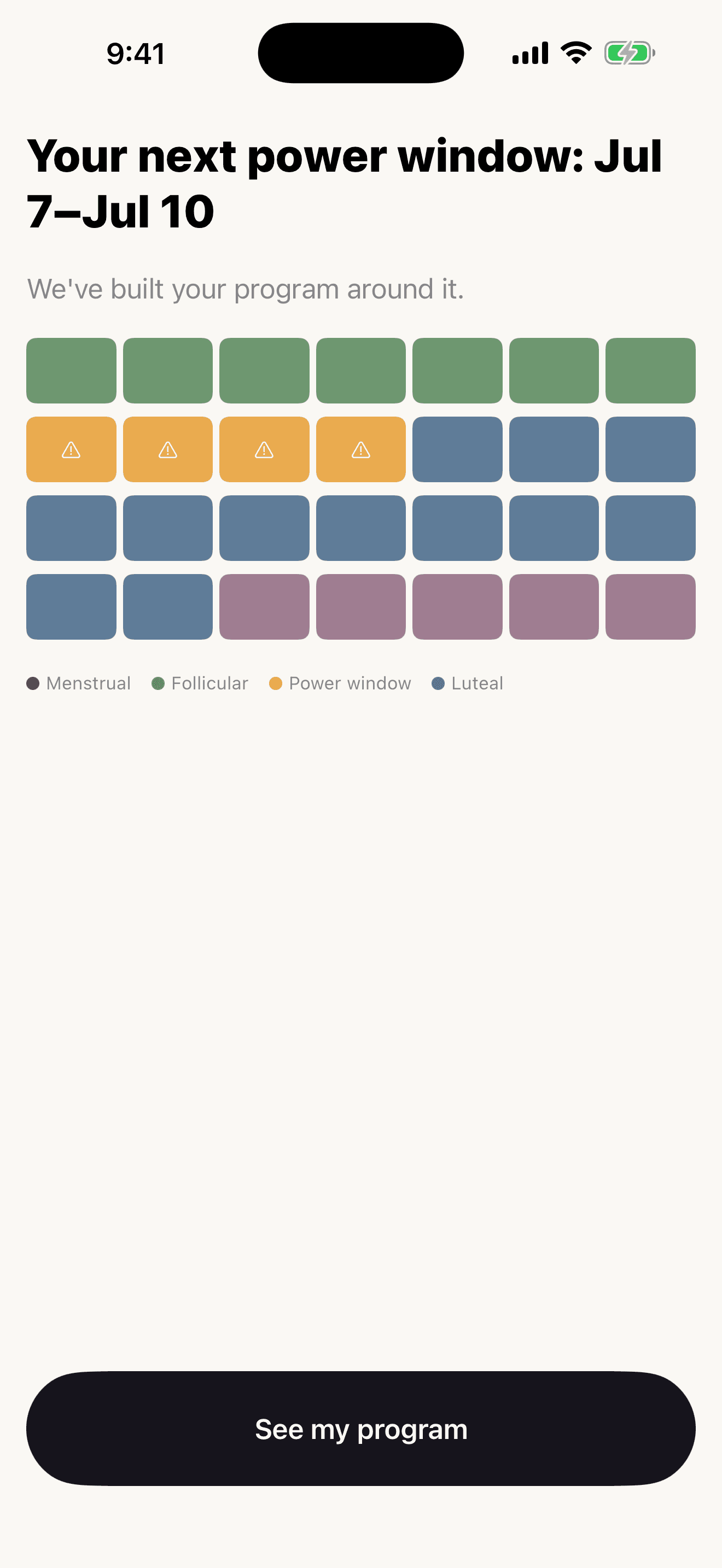
| Ovulatory (≈ days 12–15) | Peak — the power window | PR attempts encouraged; warm up thoroughly (research links ovulation with looser ligaments) |
| Luteal (≈ days 16–28) | Moderate | Volume-moderate, RPE-capped, extra rest; late-luteal deload if your cycle runs long |
Day ranges assume a 28-day cycle — yours may differ, and that's normal. The ovulatory window is what we call the power window: your cycle's statistically strongest days.
The 4-week template
Assume 3 lifting days per week built around squat, hinge, push and pull patterns. Start the template on day 1 of your period.
- Week 1 — menstrual → early follicular. Same exercises, about 20% less volume (drop a set from each lift). Nothing heroic; if energy shows up, ride it. Lifting on your period is fine if you feel like it.
- Week 2 — follicular build. Full program. Add weight or reps versus your last comparable session. This is where consistent progressive overload pays off.
- Week 3 — power window. Intensity peak: top sets heavy, PR attempts welcome. One caution: research associates ovulation with increased ligament laxity — take the full warm-up before anything maximal, especially knee-dominant lifts.
- Week 4 — luteal. Keep moving weight, but cap effort at RPE 8 (no grinders), add 30–60s of rest between sets, and hold volume steady instead of pushing it. If your cycle runs 26+ days, treat the last few days as a mini-deload.
Making it stick (without spreadsheets)
The hard part isn't the idea — it's the bookkeeping. Your cycle doesn't reset on Mondays, phases shift with your actual data, and a plan you have to recalculate every month is a plan you'll quit. That's the entire reason we built Phase: it reads your cycle from Apple Health, rebuilds this exact structure around your dates automatically, predicts your next power window weeks ahead, and logs every set like a serious strength tracker — with an Apple Watch app for the gym floor. Your cycle data never leaves your device.
FAQ
How do I start cycle syncing my workouts?+
Track your cycle (Apple Health works), note the day your period starts, and map your month: build through the follicular phase, push intensity around ovulation, moderate volume in the luteal phase, and deload near your period. Or let an app like Phase build the plan automatically from your cycle data.
Can I still train hard in my luteal phase?+
Yes — moderate doesn't mean easy. Keep lifting, but cap grinding reps (leave 1–2 in reserve), add rest between sets, and don't chase PRs. Many people feel noticeably better training this way through the second half of their cycle.
What if my cycle is irregular?+
Use ranges instead of fixed days and let logged data sharpen the picture over time. Phase widens its phase estimates when your cycle varies and labels everything as an estimate — the plan adapts as it learns your pattern.
Train with your cycle.
Phase builds this plan for you automatically — a real strength tracker with cycle-aware programming, on iPhone & Apple Watch.
Meet Phase →Phase provides general training education, not medical advice. Cycle responses vary widely between individuals; consult a healthcare provider for medical concerns. Cycle estimates are for training planning only — never for contraception or family planning.